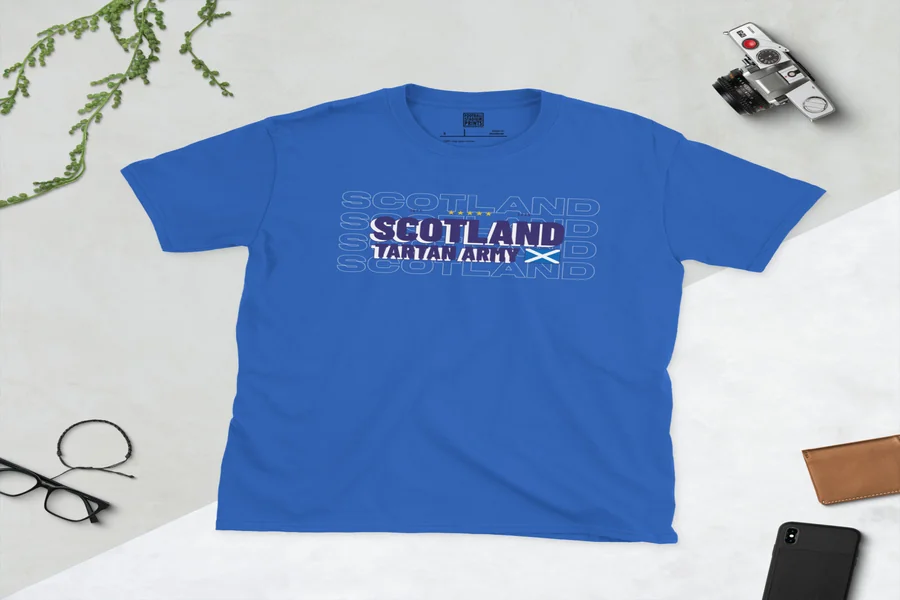
The Tartan Army transformed Scotland shirts into cultural staples by converting the dark blue jersey to the attire of one of the most easily recognized and good-humored traveling football supports. Decades of following the national team worldwide, often in bigger numbers and better spirits than the results should have warranted, these fans associated the shirt with an entire identity built on loyalty, self-mockery, and pride in showing up no matter the scoreline.
The shirt’s significance increased as the fans turned themselves into the story. The Tartan Army got the reputation of friendly and cheerful behaviours at tournaments and away matches, winning fair-play awards and gathering the goodwill of the host cities, and the blue jersey became the visible symbol of that culture. The kit ceased to be just what the players wore and turned into what the fans were, which is a highly rare thing for any national shirt to accomplish.
Who The Tartan Army Are And How They Shaped The Shirt
The Tartan Army is a nickname, or slang term rather, for Scotland’s travelling fans. It is a loosely organized group rather than a formal one, and its members are known for following the national team in large numbers to qualifiers and finals both in Europe and abroad. They made themselves known in the 1970s, 80s, and 90s when they often merchandising the spots of soccer world cups even during early exits by the team. Their behaviour overseas not only became a point of pride for the nation, but also hosts continuously applauded their actions and that image was reflected in how the Scots regarded football jersey.
The thing that differentiates this gang is that mashing up tartan kilts Highland things and blue jersey at the same time is kind of national costume. Shirt is hardly just a football shirt. To wear it plus tartan and Saltire colors mean that the man becomes a walking embodiment of Scotland, which is exactly why the jersey holds cultural significance far beyond mere sports.
Also, they injected a good humor and resilience. Scotland’s soccer history has been full of disappointments, glorious fail, and near misses, and the Tartan Army has chosen to mark on the path through experience rather than just the results. The shirt metaphorically has become the signal for you show up because you love it, whether you win or lose, and that is the major reason of popularity of the jersey.
Which Scotland Shirts Became The Most Iconic
Of all the designs, only a few have really made a mark in people’s memory collectively, and these are the ones that correspond to the country’s biggest footballing milestones. The kits from the 1978 1982 1986, 1990, and 1998 World Cups are strongly nostalgic, as these are the tournaments during which the Tartan Army first made their global reputation, and the late 70s and 80s designs have a distinctive period style that is immediately recognized as classic. The 1990s shirts, with their more vibrant patterns, are In particular popular in the retro market.
The main features repeated over and over give Scotland shirts their personality. The very dark navy blue background, the Scottish FA badge featuring the lion rampant, and the tartan-inspired hints combine to produce the unique item. When a present-day uniform has a tartan pattern or a classic collar, it is a conscious nod to this lineage as the history of the shirt is one its most powerful selling points.
Scotland’s recent qualification for Euro 2024, marking their return to a major tournament after a long absence, gave the current generation their own moment and caused shirt demand to increase. A whole group of younger fans now has a tournament of their own to associate with the jersey, thereby keeping the cultural thread next rather than just residing in the past.
What Scotland Shirts Cost And What You Are Actually Buying
When purchasing a Scotland shirt one is confronted with a decision between contemporary kits, retro reproductions, and genuine period originals, and the prices vary greatly. A current official replica generally costs between 55 and 85 for an adult size; personalised and authentic player-spec versions are more expensive. Retro reproductions of the iconic 80s and 90s designs are usually priced at a fraction of a verified original and are made of more durable, comfortable modern fabric.
Period originals are Actually a different matter. Excellent condition Scotland shirts from the 80s and early 90s can fetch hundreds of pounds based on their condition, rarity, and whether they were match-worn, and good specimens are truly scarce as these items were worn and washed for a long time rather than kept. That rarity is what attracts collectors whereas for many fans who only want to wear the shirt to a match or a screening, a reproduction will be far more reasonable.
If you want to compare the current kit against the classic designs before deciding, you can buy here and see how the modern shirt stacks up against the retro versions side by side. The honest way to choose comes down to intent. A collector chasing authenticity leans toward originals and accepts the cost and the hunt, while a fan who wants to wear blue on matchday is better served by a quality reproduction or the current kit that won’t fall apart after a few washes.
How Different Fans Relate To The Shirt
Not everyone wearing a Scotland jersey is doing it for the same reason and the significance changes given the person wearing it. For the dedicated Tartan Army member who follows the team around the country, the jersey is more than just a piece of clothing but a key to membership into a community; it is worn together with the tartan and the songs as parts of one whole matchday experience. To these people, wearing it is the same as being a travelling fan.
However, the Scottish diaspora, numbering millions across countries like the United States Canada Australia and others, see the jersey as a tangible reminder of home. Even someone who has lost their direct connection with Scotland can wear the blue shirt and experience the feeling of connectedness. Also, retro jerseys have a special place here because they often remind of a family generation or a famous tournament. In a way, this bond is slow and emotional as the one that is made at a football match.
Also, there is the group of design-conscious and younger purchasers who are attracted to the shirt as much for its appearance as for what it stands for. Old football shirts have become an established streetwear item, and the unique Scotland patterns are perfect for that, attracting those who like the kit as a cultural artifact. Studies on consumer behaviour show that people use clothing to send identity signals and wearing a Scotland jersey does that by combining both tradition and good taste.